EcoTank vs Standard Inkjet: 5-Year Cost Breakdown
By Sarah Mitchell · Published · 5 min read
The sticker price of a cartridge inkjet is roughly a third of a comparable EcoTank model, which is why so many buyers stop there. The gap closes fast once you start buying ink. A standard inkjet cartridge set often costs half the price of the printer itself, while an EcoTank bottle set runs a fraction of that per page.
This breakdown models five years of typical home and small-office use: what you pay up front, what you pay for ink, what happens at different print volumes, and where the savings genuinely stop. The numbers are ranges based on current consumable pricing and published page yields, not a single fixed quote.
How the Two Designs Actually Differ
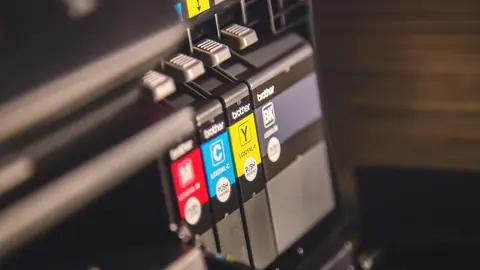
A standard inkjet ships with starter cartridges holding a few dozen pages of ink, then relies on replacement cartridges that combine the printhead, chip and ink reservoir in one sealed unit. You throw away usable hardware every time a colour runs dry, and the chip often forces replacement before the cartridge is truly empty.
An EcoTank-style printer uses refillable reservoirs filled from bottles. There is no chip to reset and no cartridge body to discard; you pour ink until the tank hits the line. The trade-off is a higher purchase price and a bulkier chassis, because the tanks sit at the front or side of the machine and the printhead is a permanent, serviceable part.
Both approaches use the same underlying piezo or thermal printhead technology, so print quality at a given resolution is broadly similar. The difference is almost entirely economic: you are choosing between paying for ink in small sealed packages or in large bottles.
- Cartridge inkjet: low entry price, high cost per page, ink locked in chips
- EcoTank: higher entry price, low cost per page, refills by bottle
- EcoTank models usually include two to three years of ink in the box
- Cartridge printers are lighter and cheaper to replace if they fail
Up-Front Price and What's in the Box
A typical A4 cartridge inkjet with a scanner costs somewhere between 60 and 130 depending on features, and the bundled starter cartridges are usually good for 100 to 200 pages before quality drops. An equivalent EcoTank model generally lands between 200 and 350, but ships with enough bottled ink for roughly 3,000 to 6,000 pages depending on the model and mix of colour.
That bundled ink is the single most important line in the comparison. If you value the included bottles at typical refill prices, you are effectively pre-buying several years of ink at the point of sale. Strip that out and the hardware gap is closer to 80 to 150 rather than the headline difference.
Watch for models with only black included or reduced bottle sizes in promotional bundles. Check the stated yield on the box rather than assuming the advertised figure applies to your mix of documents and photos.
Cost Per Page: The Number That Decides It
Cartridge inkjets typically run 8 to 15 cents per page for black text and 20 to 40 cents for colour, depending on cartridge size and whether you buy standard or high-yield units. High-yield cartridges cut that substantially, but they still cost several times the EcoTank equivalent.
EcoTank refills generally work out at well under a cent per page for black and around 1 to 3 cents for colour when you buy bottles at normal retail prices. Third-party bottles push it lower still, though printhead risk is a real consideration if quality is poor.
The practical effect is that at 100 pages a month, the cartridge printer costs roughly 100 to 180 a year in ink. The EcoTank costs maybe 10 to 30 a year. The gap of well over 500 across five years is what pays back the higher purchase price, usually within 18 to 30 months at moderate volumes.
Five-Year Model at Three Volumes
At light use, around 30 pages a month, a cartridge inkjet may never trigger enough refills to justify the EcoTank premium. Five years of light printing might mean four or five cartridge changes, and if you mostly print black text on a budget model, the total ink bill stays under 200.
At 100 pages a month, the picture flips. Cartridge costs climb past 600 over five years while the EcoTank's bottles total perhaps 100 to 150, so the EcoTank wins by a clear margin even after the higher purchase price.
At 300 pages a month or more, the cartridge printer becomes genuinely expensive and clogging risk rises if it sits idle between jobs. Heavy users also burn through printheads faster on cartridge units, since the head is replaced with each cartridge, while EcoTank heads need occasional cleaning cycles instead.
- Under 40 pages/month: cartridge inkjet often cheaper overall
- 80–150 pages/month: EcoTank typically breaks even in 18–30 months
- Over 250 pages/month: EcoTank savings are substantial and predictable
- Photo-heavy printing widens the gap further because colour ink drains fastest
Hidden Costs and Failure Modes
Cartridge printers waste ink on self-cleaning cycles that run whenever the machine wakes from standby, and you cannot recover that ink. Idle periods of a few weeks can dry a cartridge and force an early replacement. EcoTank machines also run cleaning cycles but the ink comes from a large reservoir, so the waste is cheaper.
Printhead failure is the risk that scares buyers away from tank printers. On cartridge models a dead head is solved by a new cartridge; on an EcoTank it can mean a service visit or a new printer. In practice, heads on tank models last years with regular use and occasional cleaning, but infrequent users should factor the risk in.
Other costs are shared: paper, electricity, and the occasional roller cleaning. Factor in a maintenance box on some tank models, a user-replaceable waste ink pad that costs a modest amount every few thousand pages.
When the Cheap Inkjet Still Makes Sense
If you print a handful of pages a week, mostly boarding passes and school forms, the EcoTank premium may not pay back inside five years. A budget cartridge printer plus a couple of high-yield black cartridges is a rational choice, and you keep the option of replacing the whole machine cheaply if it fails.
Colour photo printing at low volume is another case where the cartridge model holds up, because you can buy a single colour cartridge when one runs out rather than maintaining full tanks. For craft-heavy work, check what to look for in a scrapbooking printer before committing to either design.
For a small business printing invoices and labels daily, the maths almost always favours the tank model. The same logic applies to choosing between print technologies generally; our breakdown of inkjet versus laser running costs for small business covers the crossover points.
Buying Checklist Before You Commit
Compare the actual included ink yield, not the marketing headline. Look at the cost of a full bottle set at retail, the price of a replacement printhead or service, and whether the model uses a user-replaceable maintenance box. Those three figures determine your real five-year cost more than the purchase price.
If you also print large-format work or run a studio, the tank logic applies there too; see A1 plotter printer cost and feature comparison for how consumables scale at that size. And if you produce fine-art output, the pigment-versus-dye question matters as much as tank capacity, which is why choosing a printer for giclée quality is worth reading first.
Finally, check warranty terms on ink and printhead coverage. Some manufacturers extend cover when you register and use their bottles, which offsets part of the risk of a head failure.
Where the Money Actually Goes
The table below summarises the five-year model at three print volumes, using typical retail consumable prices. Treat the figures as indicative: your own mix of black, colour and photo output will shift the colour line more than anything else.
The chart shows cumulative ink spend for a cartridge inkjet against an EcoTank at 100 pages a month. The lines cross somewhere in year two, and the gap widens steadily after that, which is exactly why the break-even period matters more than the sticker price.
| Cost item | Cartridge inkjet | EcoTank | Notes |
|---|---|---|---|
| Purchase price | 60–130 | 200–350 | Includes scanner on most models |
| Included ink yield | 100–200 pages | 3,000–6,000 pages | Starter vs full bottle set |
| Black cost per page | 8–15 cents | 0.3–0.8 cents | High-yield cartridges reduce the left figure |
| Colour cost per page | 20–40 cents | 1–3 cents | Photo printing at the top of both ranges |
| 5-year ink at 30 pages/month | 120–200 | 15–30 | EcoTank may not break even |
| 5-year ink at 100 pages/month | 600–900 | 100–150 | Break-even around 18–30 months |
| 5-year ink at 300 pages/month | 1,800–2,700 | 250–400 | Clear EcoTank advantage |
- At 100 pages a month, an EcoTank typically pays back its price premium in 18 to 30 months.
- Light users under 40 pages a month may never recover the higher purchase price.
- Cartridge ink costs 10 to 40 times more per page than bottled tank ink.
- Check included ink yield, bottle prices and printhead service costs before buying either design.
Sarah has spent over a decade testing and reviewing printers for homes and small businesses. She focuses on practical buying advice, cost analysis, and helping readers avoid common printing pitfalls. Her experience spans inkjet, laser, and specialty printers.